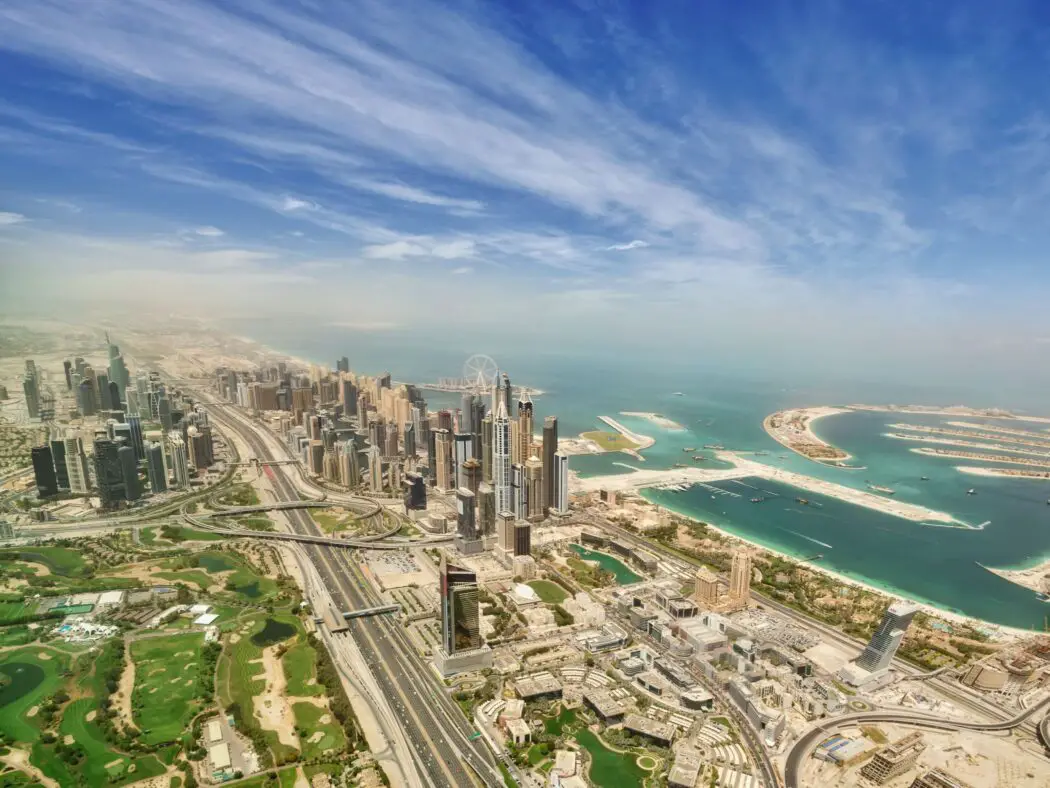
Every Dubai photo gallery seems to use the same three buildings: The top of the Burj Khalifa, somewhere in the cloud, the Burj Al Arab at sunset, and the Palm Jumeirah from above. It’s understandable as they make great photographs, but they tell you almost nothing about the city underneath.
If you stay longer than a weekend you’ll discover a different side of Dubai. It isn’t hidden exactly, it just doesn’t sell holidays.
Where do people in Dubai actually live?
Tourists queue for observation deck tickets while the rest of the city is just having a normal Tuesday. In Jumeirah Village Circle, Al Jaddaf, and Business Bay, nothing feels like downtown, and it has a totally different mood. Here, the streets have trees on them. and corner shops sell washing powder rather than sparkly watches. Kids cycle to the park and you can see the skyline from most of these streets. Out here it’s only a backdrop.
By 2024 nearly 86 per cent of the UAE population was urban, and most places you probably couldn’t name. So, what are Dubai’s new neighbourhoods really telling us? These newer communities are built so people can live, work and eat within a few streets of home. Places like the Dubai Hills Estate, Dubai Creek Harbour, Dubai South and Meydan all follow that thinking, the point being you shouldn’t need a car to fetch a pint of milk.
Binghatti is one of the top Dubai developers building in these areas. The company had handed over 12,000 homes before 2024, and plenty of those sit in mid-range communities designed around daily life rather than a skyline photo. That’s a real shift for a city built on record-breaking towers.
The practical side has improved too with most daily errands being just a 20 minute walk, cycle or metro ride away. Around 80 per cent of them, going by the planning targets. Passive cooling, solar and water recycling are being built in too. When summer regularly tips past 40 degrees, that matters far more than a marble lobby.
Dubai Design District and City Walk do a smaller version of the same idea with whops, flats and cafés within a few streets of each other. They feel like proper neighbourhoods rather than property launches.
Al Quoz is known for its art and culture
Wander through Al Quoz on a weekday morning and you’ll find something Dubai rarely gets credit for, and that’s genuine creative energy. Alserkal Avenue is the obvious place to explore but the more interesting part is the streets around it. Independent galleries and studios have taken over old warehouses, and the work on the walls feels like somebody meant it, rather than commissioning it to match a sofa.
Go on a weekday if you can as some spaces keep odd hours and it’s much quieter at that time.
Is Al Fahidi worth visiting?
Yes, and it’s the part of Dubai many locals would send anyone to first. Al Fahidi Historical District covers only a few blocks with wind towers, sand-coloured walls, and narrow lanes with no cars in them. It’s the closest you’ll get to the trading and pearling port Dubai was before the oil money arrived.
The restored courtyard houses are now small museums, galleries and guesthouses. The Coffee Museum sits in one of them and traces the drink across continents. Textile workshops nearby still use centuries-old weaving techniques, with construction cranes visible across the creek.
Allow half a day for a proper look about Al Fahidi. It gets far fewer visitors than the Gold Souk or Spice Souk down the road, which is a shame, because there’s a lot more history here.
How to find this side of Dubai
- Stay longer than three days so you have time to fit it in after you’ve seen the main Dubai sights.
- Use the metro and the abras as both are cheap and take you through parts of the city taxis skip.
- Pick one residential neighbourhood and walk it with no plan.
- In summer, go out early or after dark because nobody is outside at 2pm – it’s too hot.
- Eat where the locals queue, it’s a sign of a good restaurant.
So is the non-postcard Dubai worth your time? Definitely! By 2026 the UAE’s cities held 10.22 million people and most of them don’t live anywhere you’ve seen on a poster. They do the school run and the food shop and grumble about the traffic, like the rest of us. That version of the city reveals itself in residential streets where families from more than 200 nationalities have built something in between cultures, and the local café tucked away inside a villa compound. It’s the Friday morning football on a community pitch and the dog walkers strolling along the marina at dusk.
None of it makes a good postcard, but it’s the real city, and without that, the rest of it wouldn’t exist.