Travelling and trading might sound like daunting bed fellows, especially if you’ve not combined them before. Yet you don’t have to give up on your dreams of global adventuring, just because trading demands so much of your time. The two often work well together, and with some careful planning and diligent strategising, the experience can be rewarding as well as financially fruitful.
To help you on your way to life as a travelling trader, we’ve put together some tips and practical advice. So, whether you’re into CFD trading, technical trading, arbitrage trading, or even if you’re just getting started, these pointers will put you in the right position to succeed on the open road.
Pack the right equipment
Although you won’t want to take your entire home trading setup when you travel, there are a few things that you shouldn’t leave without. Your laptop is of course at the top of the list, but you may wish to consider packing a portable second screen if you usually have multiple screens at home. Take a spare ethernet cable too, just in case the wireless Wi-Fi connectivity in your accommodation just doesn’t cut it.
A portable power bank can be useful in an emergency but always check airline regulations on these as some no longer allow power banks in the cabin. Noise cancelling headphones can be a godsend if you’re having to work in busy public places like cafes or airports.
Universal travel adapters are a must — you might like to take multiple adapters so you can plug in several devices at once. Check the voltage and plug type in your destination and buy one in advance, since they’re not always readily available on location. Power strips can be useful too, but get one with surge protection, especially if you’re travelling around a region known for its stormy weather.
Stay connected
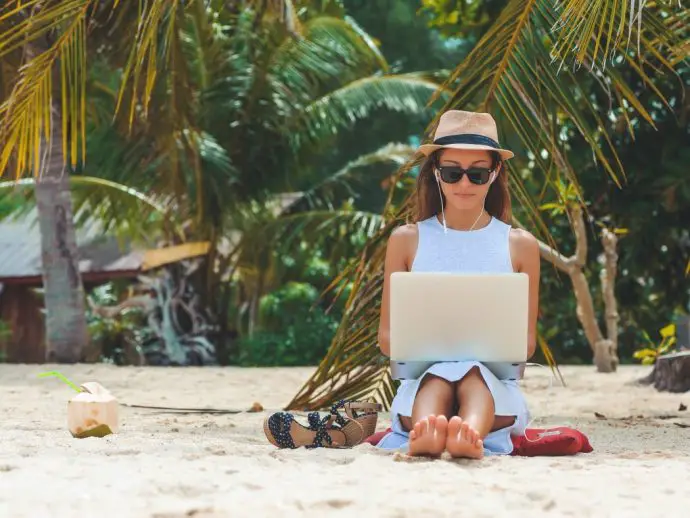
If there’s one thing you need when you’re trading and travelling as a digital nomad, it’s the internet. It’s therefore imperative that you have access to Wi-Fi when you travel, so you can stay connected at those crucial moments. You don’t want the stress of not being able to access the internet, and the potential knock-on effects that could have on your business.
So, make sure to check the Wi-Fi situation in your accommodation, whether that’s a hotel or a longer-term let. Don’t be afraid to ask your host about the reliability and speed of their internet. You can also read online expat reviews to see if people have commented (either favourably or negatively) about the internet in your chosen location, and consider that remote places and mountainous areas may not be able to provide have the bandwidth you require. Mobile hotspot devices can be useful if you’re at all concerned about how good your connection will be.
It’s also important to get a VPN (Virtual Private Network) so you can encrypt your internet traffic when accessing public networks. After all, you don’t want anyone stealing your secrets!
Consider you tax situation and don’t forget visas
When deciding to settle in a new country for a few weeks or months (or even longer!), make sure you thoroughly research the visa and tax rules. Find out which type of visa (if required) is best — tourist visas can be quite generous in some locations, but always check the rules before committing. Equally, you need to consider your tax setup and whether moving around between different overseas locations will change things.
Whilst it’s good to stay for longer periods in countries you’ve come to love and feel comfortable in, it’s important that you don’t remain in one place so long that it affects your visa validity or tax situation.
As a side note, check the trading laws in your destination (they’re not the same all over the world), and remember to tell your bank that you’re travelling, to stop transactions from being cancelled. You can often do this online or within the bank app.
Adjust your trading habits to new time zones
Time zones will affect your trading schedule so remember to factor this into your new routine. It may be that you’ll have to work some late nights or early mornings to cover the key market hours so try to plan the rest of your day accordingly.
It’s important to tweak your strategies according to time zones so that you don’t overlook key opportunities. Changing time zones can actually work to your advantage too — for example, your new trading hours might align better with peak market hours in other parts of the world.
Avoid burnout and attend to your physical and mental wellbeing

It will take time to adjust to your new routine and adapt to different trading strategies when you’re travelling, but to avoid burnout you shouldn’t overlook your mental and physical health. Being flexible with your routine is the answer — remember that change always brings challenges, but most can be overcome with the right mindset.
Taking breaks is key. Try to exercise on a regular basis, whether that’s a session in the hotel gym, a run on the local beach, or a few laps of the pool at your self-catering accommodation. Remember to give your brain a bit of time off too, after all, you’ll want to go out exploring while you’re away. Regular yoga and meditation sessions can help soothe the mind and ensure you’re in tiptop condition to hit the ground running during your next trading session. Just like at home, routine helps in more ways than one.
It’s time to get going
By following the above suggestions and planning your trip carefully, trading while you’re travelling can be a breeze. So long as you have a reliable internet connection, the right equipment, and a consideration for changing time zones, you’ll be good to go. Plans can of course change when you’re on the road, but with a flexible mindset you’ll be able to embrace any challenges that are thrown your way. Travelling doesn’t have to mean a break in trading, and the two work well together when handled correctly.