
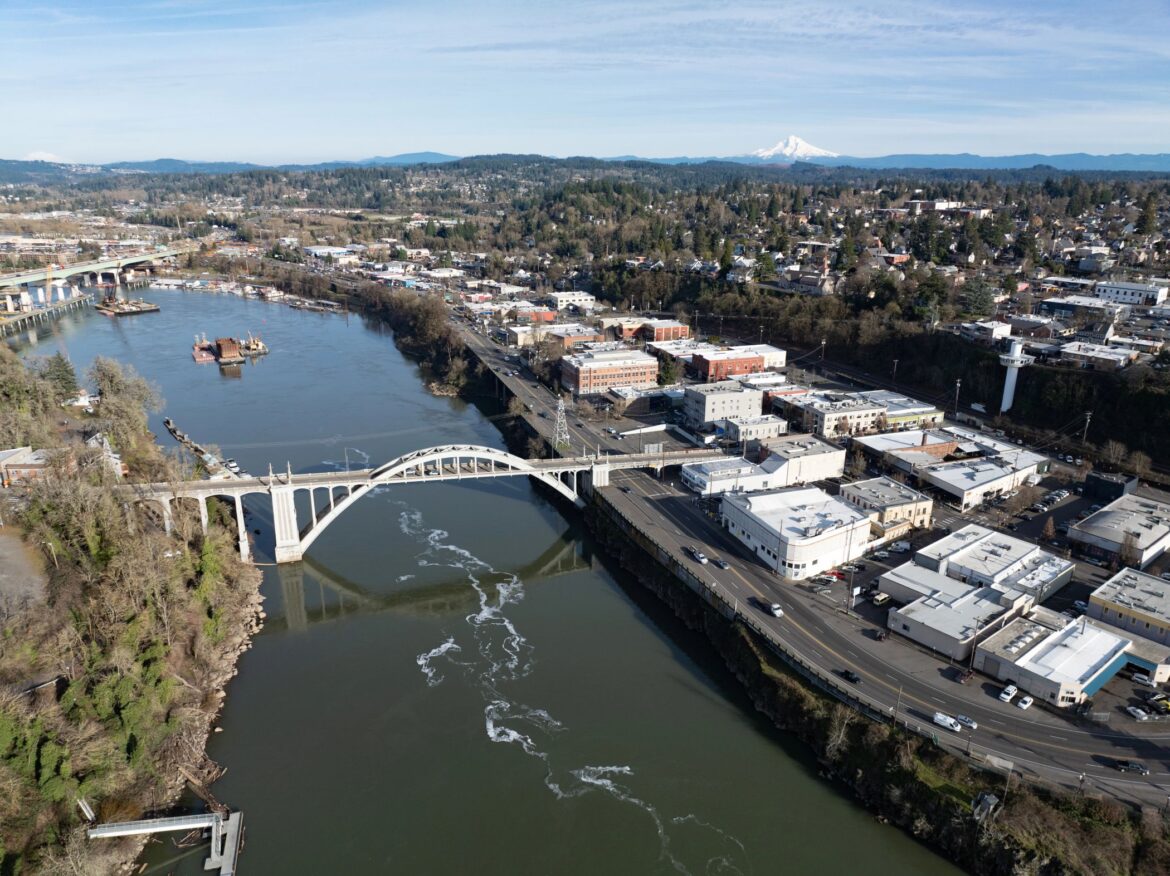
Most people who make it to Oregon get as far as Portland and stop there, which is fair enough, since Portland gives you plenty to be getting on with. Yet drive 13 miles south and you’ll reach Oregon City, which is well worth the short journey. It was the state’s first capital and the finishing line of the Oregon Trail. For about a century the mills at Willamette Falls did a lot of the heavy lifting for Oregon’s economy with timber, paper, wool and flour, all being produce because of the water coming over the falls.
The mills were of course down by the river, but the people working in them lived up on a basalt bluff about 90 feet above. That gap is what we’re talking about today.
So what is the Willamette Falls Elevator?
The elevator is a lift that’s bolted to the side of a cliff, and owned by the city, it’s free to visitors to use. Locals call it Elevator Street, because that is legally what it is. The route carries on from 7th Street, so there’s a 7th Street sign at the bottom and another one at the top. That makes it the only vertical street in North America. It’s also one of just four municipal elevators anywhere in the world, and it’s on the National Register of Historic Places.
Before 1915 people walked 722 steps
Yes, before the lift was built, anyone needing to get from the waterfront up to the houses on the bluff had to climb 722 steps. There were four sets of wooden stairs cut into the cliff, or a wagon road as an alternative. Not the kind of slog you need after a hard shift at the paper mill, or in an Oregon winter, or carrying the week’s shopping.
The city put the idea of an elevator to a vote in July 1912 and lost. They ran a second vote that December and won, allocating $12,000 to build it with.
The first elevator ran on water
The initial elevator was built from wood and steel and ran on water piped from Singer Creek. That worked out at 200,000 gallons a day. The trip up ran to three to five minutes and shuddered and groaned for most of that. Every time somebody used it, water pressure dropped in the houses nearby. When it broke down, and it did, passengers climbed out through a trap door and down a narrow ladder. Upon reach the top, there was a precarious 35-foot walkway to navigate in order to reach the street.
None of that put anyone off and on the first day of service 3,869 people rode it. That was very nearly the entire population of the town.
Why the current elevator looks like a spaceship
By the early fifties the old elevator was breaking down more than it was working. A special election in May 1952 approved $175,000 for a replacement and the new one went up in 1955. The city commission asked for a building that was “as plain as possible without adornment”. What they got, entirely by accident, is a piece of proper mid-century modern architecture with an observation deck on top that looks like a flying saucer on a stick. 751 tons of concrete and steel went into it. The tower is 130 feet tall and it gets you up there in under 15 seconds, while the old one took five minutes.
Is it worth a detour?
For ten minutes of your day, yes. It’s free, and if you ask the operator you’ll get a lifetime pass, which makes a better souvenir than anything in a gift shop. The top level has murals covering the city’s history and an observation deck looking out over Willamette Falls, the Oregon City Bridge and the Abernethy Bridge.
Don’t build a trip around it but do fit it into a morning in Oregon City during your travels across the USA.
What it actually does
People don’t really treat the elevator as a novelty. They ride it with pushchairs and shopping bags or even bikes, not for the views, but to get home quicker. So, it’s not a tourist attraction, it’s simply a piece of pavement that happens to run upwards, and it has been closing a 90 foot gap in the middle of somebody’s commute for over a hundred years.
Which is a lot more useful than most things with a viewing platform on top.